
FPL DGW & BGW Guide: Chip Strategy Data
I optimised chip strategies for 323 real FPL squads in the 2025/26 run-in. For each one, every valid Wildcard, Free Hit, Bench Boost, and Triple Captain combination across the remaining gameweeks was tested by FPL Copilot's solver.
The GW numbers below belong to 2025/26, but the window logic repeats every season: WC before the DGW, BB in it, FH on the blank, TC on the ceiling week. Here's what the data showed.
The Most Common Optimal Strategy
WC32. BB33. FH34.
55% of all squads. Wildcard in GW32 to rebuild around the double gameweek players, Bench Boost in GW33 when the fixtures are strongest, Free Hit in GW34 for the blank. Add Triple Captain in GW36 and that covers 69% of teams.
WC32 BB33 FH34
Most common optimal
55%
+ TC36
With Triple Captain
69%
Points gained
Best combo (all chips)
+70.7
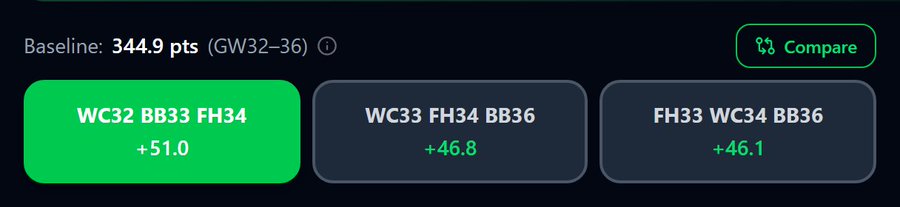
The top three strategies for managers with all chips remaining:
1. WC32 BB33 FH34 TC36 = +70.7 pts over baseline
2. WC32 TC33 FH34 BB36 = +68.4 pts
3. WC32 TC33 FH34 BB35 = +68.2 pts
The gap between #1 and #2 is only 2.3 points. But the gap between optimal timing and random chip placement is 20-30 points. Getting it roughly right matters far more than perfection.
No Wildcard Left?
The optimal strategy shifts entirely based on which chips you still have. There is no universal answer.
For managers without a Wildcard:
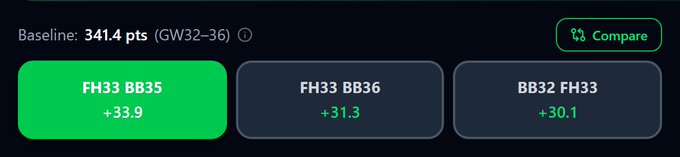
1. FH33 BB35 = +33.9 pts (7% of squads)
2. FH33 BB36 = +31.3 pts
3. BB32 FH33 = +30.1 pts
Without a Wildcard, you can't restructure your squad for the doubles. Free Hit becomes your best tool for the blank GW, and Bench Boost shifts to whichever double gameweek your existing bench is strongest for.
The Numbers Across 323 Squads
Average improvement from optimal chip timing: +49 points over a no-chip baseline.
Average gain
Over no-chip baseline
+49
Gained 40-60 pts
Majority of squads
69%
Best case
From timing alone
+73
69% of squads gained 40-60 points from optimal chip timing. 14% gained 60-73 points. The best case was +73 points from chip timing alone. No extra transfers, no hits, just playing the right chip in the right gameweek.
Per-Chip Breakdown
WC32: 97% of squads with a Wildcard. Double gameweeks drive it. Wildcarding in GW32 lets you rebuild around players who double in GW33, then carry that squad through the run-in. Nearly universal.
BB33: 72% of squads. GW33 has the strongest bench fixtures in the run-in. After a GW32 Wildcard, your bench should be loaded with doublers. All 15 players playing twice means 30 individual fixtures generating points.
FH34: 79% of squads. Blank gameweek. Half your team might not have a fixture. Free Hit lets you field 11 players who actually play. Save it for the blank, not the double.
TC36: 73% of holders. Highest ceiling double gameweek remaining. Your best captain option plays twice against favourable opponents. Also the last realistic spot for it.
WC32
Nearly universal
97%
FH34
Blank gameweek
79%
BB33
Strongest bench DGW
72%
Common DGW Mistakes
Taking hits to get doublers: A -4 hit to bring in a player who scores 4 points across two games nets you zero. The solver factors in hit costs. Sometimes keeping a single-GW player in form beats bringing in a doubler for a hit.
Ignoring fixture quality: Not all doubles are equal. A player doubling against Liverpool and Arsenal is worse than a single-fixture player against Ipswich. Expected points account for this. Raw “is it a double?” thinking doesn't.
Using Free Hit on the double: Your squad probably has 8-10 doublers already. Save the Free Hit for the blank where you might only have 6-7 players with a fixture. 79% of optimal strategies agree.
Bench Boosting without a strong bench: BB with four 4.0m benchwarmers who might not play both games is a waste. If your bench isn't loaded with starters who double, consider TC on your best captain instead.
Your Squad Is Different
Each of the 323 strategies was built for that squad's specific players, budget, and remaining chips. The percentages above are patterns, not rules. Your optimal strategy depends on your squad.
The chip strategy optimizer tests every valid combination for your team, runs the full solver for each scenario, and tells you exactly which chip to play when, and how many extra points each placement is worth.
FAQ
What is a DGW in FPL?
A DGW (Double Gameweek) is when one or more Premier League teams play two matches in a single FPL gameweek. Players from those teams can score points in both fixtures, making DGWs ideal for Bench Boost and Triple Captain chips. DGWs occur because of rescheduled cup or postponed league fixtures.
What is a BGW in FPL?
A BGW (Blank Gameweek) is when one or more Premier League teams do not play in a given FPL gameweek. Managers with multiple players in blanking teams can have 4-7 players without fixtures. The Free Hit chip is designed to cover blank gameweeks by swapping in a full 11 of playing starters for one week only.
What is a blank gameweek in FPL?
A blank gameweek is a gameweek where fewer than 10 Premier League matches take place because of cup finals, international duty, or rescheduled fixtures. Managers with players from blanking clubs have gaps to fill. Free Hit is the cleanest chip to cover a BGW; the alternative is taking hits on transfers.
How do double gameweeks work in FPL?
During a DGW, selected Premier League clubs play twice because their calendar has been rearranged. Players from those clubs can score in both matches: two sets of goals, assists, clean sheets, and bonus. Your captain triples on DGW matches, and Bench Boost counts the bench across both games. The full FPL schedule lists confirmed DGW fixtures gameweek by gameweek.
What is the best FPL chip strategy for a double gameweek?
Wildcard before the DGW to load up on doublers, Bench Boost during the DGW, Free Hit the blank, Triple Captain the highest-ceiling DGW. In the 2025/26 run-in that sequence (WC32 + BB33 + FH34 + TC36) was optimal for 55% of 7,124 analysed squads. The window logic repeats every season once doubles and blanks are confirmed.
When are FPL double gameweeks confirmed?
DGWs are created by rescheduled fixtures, usually from cup postponements, so they are confirmed during the season rather than at the start. Most land in the second half, with the biggest doubles and blanks in the spring run-in. In 2025/26, GW33 was the largest double gameweek. FPL Copilot flags confirmed and predicted DGW teams as reschedules land.
How do I prepare for a double gameweek in FPL?
Three steps: (1) identify confirmed DGW teams before the chip deadline, (2) use Wildcard or targeted transfers to load 10+ players from doubling clubs, (3) plan Bench Boost or Triple Captain around the DGW and save Free Hit for the blank. The xPts table already accounts for DGW fixtures in its projections.
Should I chase DGW points or hold my chips?
Depends on DGW size and your remaining chips. A 10+ team DGW with all chips available is prime BB + TC territory. A smaller 4-6 team DGW with chips already used is a hit-taking decision based on solver output. Running the chip optimizer with your exact squad and remaining chips gives the definitive answer.